
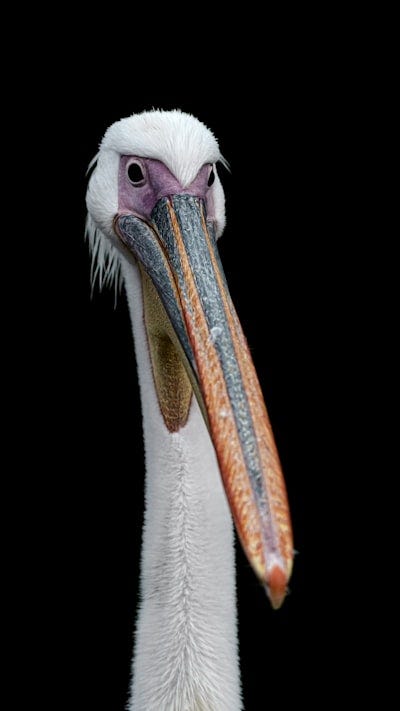
To celebrate the recent hatching of four pelican chicks in St James’s Park - the first to be born there in 360 years - I modestly offer this celebration of the healing powers of pelicans which I wrote some time ago. If you’ve read it before I apologize. But it’s a free gift and I will understand if you discard it, just as I will understand if you buy it to send to someone you love.
Sometimes you have to put yourself in another person’s shoes, see the world as he sees it, even if he is an ex-Nazi vivisectionist and bone surgeon who’s been hiding out in a quiet Australian country town since 1946 listening to Great Speeches from the Reich on his phonograph and wondering if he’ll ever again be given a Jew to experiment on. See what he sees, then - Dr Ernst Mengele: Osteopath, Chiropractor and Specialist in Sporting and Other Injuries - when he responds to an urgent out-of-hours ringing at his bell and finds an unambiguous Jew of tractable disposition twisted like Richard III on his doorstep, his back gone into serious spasm, his face contorted with pain, and the words ‘Help me, help me!’ on his lips. It is not often you are the answer to another person’s prayers. And you don’t always realize that’s what you are until it’s too late. But when he welcomed me in and promised me relief, I believed it was he who was the answer to my prayers, and not the other way round.
I had been driving from Melbourne to Sydney along the coast road when my back went. An old injury that sometime flared when I spent too long behind the wheel. But it had never flared as frighteningly as this. I couldn’t feel anything between my shoulders and my knees. I couldn’t move. There are some pains I don’t mind suffering. Fevers I enjoy. Any ache for which the only cure is rest and heat and a bottle of red Italian wineI welcome as an excuse for voluptuous idling. And a seized-up back, rendering you helpless everywhere but in your extremities, excusing you from all chores and exercise except of the intellectual sort, belongs to this family of perverse pleasures. But not when you are 13,000 miles from home, and driving.
The only way I could get out of the car was for somebody in the passenger seat to push me out. Fortunately, I was with an Australian woman - when I say ‘with’ I mean ‘married to’ - for whom pushing me out of the car was a pleasure second only to driving over me in it. But let’s not go there. Marriages get to this point sometimes and this isn’t a marriage story anyway. It’s a story about an ex-Nazi bone surgeon and a pelican, and if that sounds magic-realist, well life occasionally is magic realist.
It was magic enough, for a start, that I stopped the car where I did, right outside Mengele’s gate. This was a very small farming town close to the Victoria/New South Wales border. It would have been reasonable not to expect to find an osteopath for a hundred miles in any direction. So to have rolled up literally at his front door was nothing short of miraculous. Which was clearly what he thought, too.
He was a small wiry man, completely bald, perhaps eighty years of age but with the alertness of someone who knew that his hour would come again and had been keeping himself fit for when it did. He spoke with one of those Concentration Camp accents Laurence Olivier invented, but with an absurd overlay of Australian which made him sound like an American trying to imitate Cockney. He offered me a beer. It was hot enough for a beer, but my nerves were as tensed as my spine and I needed that slow permeation of calm which only English breakfast tea can achieve. He narrowed his eyes as though this were a test. Was that how the great Nazi-hunters flushed out their men - by asking them to make English breakfast tea and seeing what they did? In fact he did have tea and knew how to make it. He had chocolate digestive biscuits as well. And white embroidered napkins. There was nothing he hadn’t thought of.
He helped me into an armchair, took some personal details: name - ‘Jacobson? Good, good. How are you spelling that?’ - address, religion, age, sex, religion, medical history, religion, then said he wanted to have a look at me standing up. The fact that he had got me to sit down before asking to see me standing up should have given me a clue to the sort of man he was. Because once in the chair I couldn’t get out of it again until he’d reconfigured me. This he did with brute strength, wrestling me onto his carpet, rolling me on to my side, and then twisting the top half of me in one direction and the bottom half in another. Something snapped in my spine. ‘As I thought,’ he said.
I was with him for about two hours in the course of which he twisted me several more times, repeated the phrase ‘As I thought,’ then at last took me into a room marked X-RAYS KEEP OUT. It looked pretty ancient equipment, but how many osteopaths in rural Victoria had any X-ray equipment?
By this time any man with his wits about him would have begun to form suspicions about Dr Mengele. And I’m not saying I did not have my concerns about one or two aspects of his personality, let alone his surgery. But it’s part of that feverish voluptuous idling of which I’ve spoken that I willingly yield to a stronger person’s will when I am ill. Let them only offer assistance and they can do whatever else they want with me.
He arranged several glass plates, led me to what appeared to be a darkened mirror which pulsed on catching my reflection, told me to breathe in, breathe out, breathe in and hold, then put on a pair of goggles. ‘Shouldn’t those be for me?’ I asked. ‘Just hold your breath,’ he said, pulling a lever. From somewhere in another room I smelled burning.
Next he got me to stand up against a wall that had pegs in it and measured me. ‘It’s as I thought,’ he said, ‘you have one leg shorter than another. That’s what originally caused the problem with your back.’
What originally caused the problem with my back, I told him, was falling down a flight of concrete steps in a Cambridge college twenty-five years previously. In fact I’d always believed I’d been pushed by a student who hadn’t liked what I’d written on his essay, but had never been able to prove it. Ever since that fall, whether it was an accident or an act of malice, I’d been subject to seizures such as these, though none quite so serious. As for having one leg shorter than another, no tailor had ever pointed this out to me. The length of my trousers was the same on each leg, and my trousers fitted perfectly. Indeed - in Australia at least - I was known for the elegance of my ‘strides’.
‘The X-ray,’ he said, ‘cannot lie.’
How he’d managed to prepare an X-ray in the time I didn’t know. Back in England you went to hospital for an X-ray in January and if you were lucky you got the results before the end of the year. Perhaps the X-ray he showed me wasn’t mine. Perhaps it was an X-ray of some poor Jew whose legs he’d realigned in whatever camp he’d worked in. Perhaps it was an X-ray of Hitler who almost certainly had one leg shorter than the other, two legs shorter than the other if rumours are to be believed. What it showed, anyway, was that my spine was as crooked as the Leaning Tower of Pisa.
‘Christ!’ I said.
He looked at me evenly, as though surprised I’d heard of Christ. ‘Precisely,’ he said. ‘Christ!’
‘About which I do what?’
‘Either you leave it and your back disintregrates further until at last you cannot move and have to be wheeled from room to room if you have anyone to wheel you - ‘
‘Or?’
He took a moment to think about his answer though he certainly had it ready.
‘Or I perform a small operation,’ he said.
‘You are qualified to perform operations, I presume.’
He inclined his head as though impressed I’d heard of him. What he didn’t say, though it must have pained him not to, was ‘Ernst Mengele, surgeon to the Führer, at your service.’
‘You are attached to a hospital?’ I asked.
He smiled at me. Who needed hospitals? ‘I can do all that needs doing here,’ he said. ‘It is only a very small operation.’
‘Removing a piece from my leg, a very small operation?’
‘Who said anything about removing a piece?’
‘Putting a piece back, then.’
‘You obviously don’t know how far science has progressed,’ he said.
‘No, I don’t,’ I admitted, recalling that Charles Bovary had said something similar before horribly botching an operation on Hippolyte Tautain in ‘Madame Bovary’. ‘The question is, do you?’
He threw me that Laurence Olivier, demented dentist look. I considered myself fortunate not to be in a chair that tilted backwards.
‘I have performed this operation countless times before,’ he said.
I am a fool about my health, a gullible fool when it comes to trusting myself to doctors of any sort because the workings of the human body - especially my own - are such a mystery to me that I revere anyone for whom they are not. But I was not such a fool as to lie down there and then on Dr Mengele’s couch, while my wife sat listening to the car radio in the road outside, hoping I would not come out alive, and let him match my legs.
‘I will have to think this over,’ I told him.
‘What is there to think?’
‘Whether I wouldn’t prefer to be wheeled from room to room . . .’
‘. . . if you can find anyone to wheel you.’
I decided against the operation, for the time being at least. I’d drive on to Sydney and speak to someone there. In the end you can’t really trust a country doctor, wherever he’s received his training.
Twelve miles up the road, in a lovely fishing village just into New South Wales, I seized up again and wondered whether he could possibly have been right and that surgery was my only recourse. I was able to find just enough strength in my foot to apply the brakes, and pulled the car up by a grassy verge. My wife got out, opened my door, unlocked my seat-belt, walked back to the passenger seat, got back in, and shouldered me on to the verge. There is no end to the ways love can express itself. I couldn’t move. I lay on my back like Prince Andrei at Borodino, gazing up at the clouds, reasoning that life had no meaning whether my legs were even or odd. A great depression seized me. The depression of the physically imperfect. Who cared what anyone did to me? Nothing mattered.
Suddenly I realized I was being stared at. Not a human stare, a bird stare. A pelican had hopped down off a post from which it must have been fishing to look me over. An Australian pelican is a huge bird and when it opens its massive salad-server beak it can be terrifying. But this pelican’s intentions were benign. It was curious, that was all. And perhaps concerned by the sight of my being shouldered out of the car.
They enjoy a various reputation, pelicans. The old testament speaks of the lonely pelican of the wilderness, as though the bird stands for something solitary in the heart of man, which is how I think of the pelican myself - as a sort of spiritual companion in the great immensity of things. And in medieval art and church architecture the pelican was a symbol of Jesus Christ. The reasons for this are interesting. The pelican was mistakenly thought to kill its own young - though in fact the young were merely convulsed with overeating from its father’s beak. Seized by remorse, the fancy went, the pelican pierced its own breast from which sprang a fountain of blood. This blood, spattering the corpses of the dead pelicans, miraculously brought them back to life again. Hence the analogy with Jesus Christ who gave his blood that we might live.
He looked down at me - the pelican, that is, not Christ - with a single red-black eye. Would he pierce his breast and with his blood heal my spine and revive my spirits? No, he didn’t do that. He just stared and stared, putting himself between me and the sun until all I could see was the great whiteness of him. How long I lay there, under his wing as it were, I don’t recall. But I was aware at last that the soreness had gone and that I could get to my feet without help. And as soon as I did that he turned aside, no longer interested in me, and went off on one of those long loping pelican runs and finally got himself airborn.
A specialist in Sydney explained that when the back goes into spasm it twists the spine so that in an x-ray it resembles the Leaning Tower of Pisa.
‘And makes one look lopsided?’
‘Exactly.’
‘So I don’t have one leg shorter than the other?’
‘Who told you that?’
‘Just some Nazi,’ I laughed.
‘Well there are plenty of them out here,’ he said, prescribing me Voltarol.
I spent several months in Sydney having a good time. There is no city in the world a man can have a better time in, especially when he has just discovered there is nothing wrong with him that long walks and Voltarol won’t cure. Driving back, I thought of calling in to see Mengele. I wanted to show off the perfect identity of my legs. Perhaps kick the living daylights out of him. Demonstrate what pain a pair of exquisitely symmetrical Chosen Person’s legs can cause. But a dozen miles before I got to his town I saw my pelican. A pelican, anyway. I pulled in to where he was sitting on his post, gazing out across an ocean of fish. He showed no sign of recognizing me. I was travelling alone and so had no one to roll me out. But I didn’t need anyone. That was how good my back was now: I could push myself out of a car. I lay on the grass verge on my back and waited. At last the pelican hopped clumsily off and ambled over to me, interposing his whiteness between me and the sun. The thought that I was falsely trading on his sympathy made me sit up. He stared, unmoved. Maybe he was wondering where my wife was. Or maybe he wanted to see if I could get to my feet unaided. So that was what I did.
End of story as far as he was concerned. Ten a penny, a man on two legs. This time he didn’t fly off, just turned away to see what else was interesting.
I have a fancy about birds, particularly pelicans. Ancient Mariner stuff. They are creatures of good-omen. You leave them in peace. They mean us well, or the idea of them means us well. So you don’t shoot them. Nazis you shoot, pelicans you don’t.
But I didn’t call in on Mengele. I thought it was punishment enough leaving him to his disappointment. Knowing that his last big chance had come and gone forever. For it doesn’t happen twice to an ex-Nazi vivisectionist living in hope in rural Australia that a seized-up Jew with one leg shorter than another rolls up at his door and asks for help.
I could have been wrong but I believe I saw him looking out of his window, waiting, waiting….
END
Your writing delights me every time. Please, don't get out more, if it means cheating us of visions like this one. Stay in, and scribble.
Loved this, like everything by you, Mr Jacobson. I am at the moment enjoying Mother's Boy. However... this story really reads as magic realism :-) . Mengele's first name was Josef and after a brief spell in Olivos (Buenos Aires), where General Perón so kindly invited him, he disappeared... (I am only adding data that you already know), Paraguay? Brazil? Who knows? In any case, had I been in your shoes, I would have also avoided any surgery by any of the Mengeles of this world :-)